Concerns of Circle CEO when its comes to Facebook Crypto Project, Libra

During an interview with Bloomberg, on the 5th of July, the co-founder as well as CEO of payments company Circle, Jeremy Allaire quite clearly stated that facebook’s Libra would work in the closed-loop license system that has its own requirements for regulation.

Elaborating his views further, the CEO said:

“There’s a really key difference between stable coins that run on the kind of closed-loop permission schemes — which is how Libra is being proposed today, at least in its initial incarnation — versus stablecoins that can run on the public internet.”

Allaire additionally determined that the latter is the kind of USDCoin (USDC ), that stable coin jointly established via round and USA cryptocurrency alternate Coinbase.

He additionally knew that he hopes Libra would make the transformation of nationwide policy policies involving virtual properties. He noted:

“Our perspective is that you realize, crypto and blockchains represent sort of the fabric of the 21st-century business system, And there’s the opportunity to take in position coverage that allows us to grow on a massive scale at this same ways that the system flourished within the mid- to late-nineties and coverage used to be truly important to enabling that.”

Coeure’s answer is at keeping with these predictions of Jeremy Allaire, co-founder, and CEO of bills firm round. In the interview with Bloomberg established early this week, Allaire famous that he hopes Libra can make the advancement of nationwide policy policies pertaining to virtual belongings.

Monero Discloses Vulnerabilities Indicating Serious Misuse By Rouge Miners


Monero, a privacy-focused altcoin has suddenly disclosed nine security vulnerabilities — including one that could have allowed hackers to steal XMR from cryptocurrency exchanges.

 Rogue Monero miners were hypothetically able to create “specifically-crafted” blocks to force Monero wallets into accepting fake deposits for an XMR amount chosen by the attacker until March.

“It is our belief that this can be exploited to steal money from exchanges,” said security researchers in their initial HackerOne report. They were eventually awarded 45 XMR ($4,100) for their efforts.

Five DoS attack vectors were also disclosed, with one labeled “critical” severity. Another related specifically to CryptoNote, an application layer used by Monero to increase transactional privacy.

 This flaw could’ve seen bad actors take Monero nodes down by maliciously requesting large amounts of blockchain data from the network.

Andrey Sabelnikov, who discovered the bug, told Hard Fork:

“If you have quite a big blockchain, then you can push a protocol request that will call all of its blocks from another node, which could be hundreds of thousands of blocks.” “Preparing such a response can take a lot of resources. Eventually, the OS might kill it due to the huge memory consumptions, which is typical of Linux systems,” he added.

Monero software was also found to have been leaking “uninitiated” memory to untrusted network peers. This kind of memory reportedly could have included sensitive material. Emerging crypto software like Monero is going to have bugs. 

The bulk of these bugs was submitted roughly four months ago. Eight vulnerabilities have since been patched, while one remains almost entirely undisclosed. The reports appear to be timed to coincide with the release of Monero version 0.14.1.0 in June.

It should be noted that most of these flaws were described as “proof of concepts.” At pixel time, there have been no reports of these bugs being exploited in the wild.

Last year, a bug in Monero wallet software was found that would have allowed XMR to be drained from wallets (owned by cryptocurrency exchanges, for example) in targeted attacks.

At the time, devs warned its discovery should remind the public that cryptocurrency (and related software) is still in its infancy and that it’s very much prone to critical bugs — so I guess we should consider ourselves reminded, nine more times.

India Makes Libra Illegal, But Should Libra’s Potential Be Ignored?

Facebook’s Libra campaign has taken the crypto world by storm with Facebook announcing its plan to launch Libra, an international digital currency, next year. Will Libra be beneficial for the common Indian or is it another gizmo?

Libra is supposed to be a virtual currency that would be a non-government alternative to national currencies. Its value, however, is not linked to rupees, or dollars, or any particular national currency. Its value would be linked to a basket of bank deposits and government bonds in heavyweight international currencies including the US dollar, Euro, UK pound, Swiss franc, Japanese yen.  

At the back end, the underlying technology is going to be a limited kind of blockchain or distributed record of transactions. The transactions would take place through a digital wallet called Calibra.

Facebook claims that globally it has around 2.4 billion users, of which about 10 percent are from India. This means about 24 crore people to start with. As per the Ministry of External Affairs, overseas Indians are estimated to be about 3 crores. 

In 2018, according to the World Bank Brief on Migration and Development, overseas remittances to India was of the order of $ 80 billion (Rs. 5.7 lakh crores), the highest in the world. These remittances, when taking place through formal channels, cost on the average seven percent, according to the same Brief. It is claimed that the transfer of Libras will cost just a fraction of a percent. We can see straight away the potential for huge cost savings.

To be a credible player in the international money transfer market, Libra would need to ensure secure fund transfers from person to person at negligible or no cost; and enable the easy exchange of the currency into local currency and vice versa, as needed. As projected, it ticks almost all the boxes. The exception is the issue of exchangeability, which is not in its hands, as it requires regulatory approvals from the Reserve Bank.

If it does cross that hurdle, it would make a lot of sense for both senders and recipients alike. Recipients of such transfers are usually people who need the cash. They are therefore likely to value the drastic reduction in commissions that are promised. Apart from which, no bank account would be needed to come on board, only a mobile phone, and internet access.

Another feature of Libra not related to the transfers per se is that the Libra Association will release the open-source code so that anyone can develop third-party apps on this platform. This has the potential to open up fresh development opportunities for our techies and open up new horizons for our entrepreneurs.

Downsides are there of course, and many of them have been pointed out already. An enormous amount of data would be captured by the Libra Association, and this has raised privacy concerns. Facebook has promised to keep the payments data separately from its social media, but authorities in the Western world are skeptical, given Facebook’s past record.

Libra accounts may also be subject to the risk of hacking but so are all digital payment accounts, including those of banks and credit cards. Safeguards will be needed in much the same way as for banks and credit cards. Another danger highlighted is that the same channels can be used by money launderers and movement of funds by and for criminals.

The real hurdle that Libra will have to cross before it can become widely accepted as envisaged is that of regulatory approvals. Without the Reserve Bank of India (RBI) agreeing, Libra will not be interchangeable with rupees. It can still come into being and be used, without such approvals, but the spread that would be limited.

As of now, such a currency is illegal. RBI notification of 6 April 2018 prohibits all entities regulated by it (i.e. all banks and financial institutions) from dealing in virtual currencies.

Government of India policy is also not supportive. There are reports of a draft “Banning of Cryptocurrency and Regulation of Official Digital Currency Bill, 2019” which proposes to criminalize holding of cryptocurrencies (which would include Libra), making it a non-bailable offense with a ten-year jail term.

With the big names and deep pockets backing the initiative, Libra is likely to see the light of day soon. There are potential benefits for people in India. New mobile and net-based technology applications can be quite disruptive if people catch on to them. We don’t know yet whether this one will succeed or fail. There are as yet many grey areas in the proposal. We can choose to look at it with an open mind or ignore it.Pinter

As Bitcoin Tends to be Unstoppable, Majority of the ALtcoins can be seeing trading sideways.

  Since there is no doubt that 2019 is perhaps the year of Bitcoin, as it seems almost unstoppable. Moreover, there are various other coins that are largely affected by the insane rise in Bitcoin prices.

As yesterday was Independence Day in the United States, the majority of analysts believe that BTC will undoubtedly touch the heights once again.

Speaking of which there have been some interesting statements made by the crypto analytics website, SFOX. It says that while in the midst of a bull market, holidays can literally spark the term FOMO.

It further said:

“At times when the market is already doing well or improving, holidays have the potential to drive renewed retail interest in buying bitcoin and other cryptocurrencies. That behavior, almost by definition, is FOMO: buying into an asset because one sees it trending upward and wants to benefit from it.”

A Brief Glance at Altcoins

Since its already well known that the enormous gains of Bitcoins have ultimately left the market a bit unstable.

As ETH is currently seen to be trading sideways at around $300.

Whereas Poloniex is planning to implement a not only a faster process for transactions as well as deposits but also the cheaper ones.

As far as Ripple is considered, the exchange is found to be trading almost sideways along with some minor losses.

Truth be told, XRP has actually been witnessing downtrend since its monthly highs on 22nd June as 26th June

Facebook’s Cryptocurrency Libra is unique and beyond comparison to Bitcoin

You’ve probably come across Facebook’s newly discovered cryptocurrency, Libra. The news drew the attention of international media and dominated headlines for about more than two weeks from the time of the official announcement. But if we first hear about it, welcome to the future where the data wasn’t sufficient and now Facebook wants to control monetary policy as well.

Those of us who were in Bitcoin’s sphere knew that Facebook had been working for the cryptocurrency from some time, but we weren’t able to know how it exactly looks like till 18th June 2019. Well for many in the cryptocurrency market, it was somewhat we expected, Libra isn’t a cryptocurrency and also didn’t benefit the Bitcoin.

What’s the mystery of Cryptocurrency?

Bitcoin, the world’s first cryptocurrency, popular in pop culture for its wild price fluctuations, is called cryptocurrency because it uses encryption for transaction processing and transfer value. This end-to-end encryption makes transactions very secure and irreversible. These transactions are recorded on the so-called Blockchain. This technology, the backbone of the Bitcoin Network, acts as a digital book that maintains unchanged and constant up-to-date information about all account balances on the network and ensures that nobody cheats on the system to spend the fake coins.

The main features of the Bitcoin Network are its un-changeability, safety, permissionlessness, and decentralization – all transactions are final, the network is virtually impossible to compromise, everyone can use it as freely as the Internet itself, and no central organization or bank) controls it. The currency of the network, bitcoin is rare and cannot be censored. The number of bitcoin that will exist will be 21 million, and the currency is unreasonable for the police or to be banned alike internet.

Bitcoin is also global as an endogenous currency for the internet. Sending Bitcoin from Nashville to, say, Seoul, South Korea may take only a few minutes, depending on the transaction fee that the sender determines. On the contrary, a bank card may take up to a week.

Why Libra doesn’t fall under the category of Bitcoin?

In order to understand Libra’s importance in the wider cryptocurrency world of which there are thousands, it is better to understand how Bitcoin works and why its users see value in a decentralized, non-national monetary system. By highlighting how Bitcoin works with Libra, it is clear that they both have so many things in common as the Federal Reserve’s monetary policy is doing with mining of gold or a corporate powerhouse with a company owned by employees.

For example, Libra is closed and will be heavily hidden unlike Bitcoin, which is an open system. Facebook has announced the currency in partnership with 27 other major corporations, businesses and nonprofit organizations including Visa, MasterCard, Spotify, Lyft, Uber and Ebay. These founders form the Libra Association, which will be responsible for processing network transactions and maintaining its version of a blockchain. Until the beginning of the coins in 2020, the project hopes to enlarge to about 100 members.

This means that only 100 servers, also known as nodes, will support the network. Bitcoin, on the other hand, has about 11,000 units globally to check and broadcast transactions to the rest of the network. These “full nodes,” as they are called in the crypto industry, are accompanied by “mining nodes” that provide computational power to order blockchain transactions and protect the network from attacks. They receive transaction fees and freshly cut Bitcoin from the network as a reward for this service; this coin-retrieving process, which set free freshly extracted coins with a fixed inflation schedule (right now, approximately 2% per annum), is the way the network manages monetary policy without a centralized organization. Together, these nodes build a decentralized framework that makes Bitcoin so healthy that if you want to bring down or compromise one of these nodes, the network will still be safe due to the fact that thousands of others still uses the code to support the network.

In any case, Libra will not be decentralized or offer protection for Bitcoin design features. With Bitcoin, everyone can manage a full or a node, but with Libra, each founder had to commit a minimum of $10 million to have the pleasure of joining the network. In the future, if any other organization wishes to join the Libra Association will have to pay a similar or even higher amount.

Also, with becoming a protector of an entirely new monetary system, they will also be given awards for deals and bonuses from the Libra Reserve. The assets that are government-backed such as the national currencies, bonds, and securities, will be included in this basket. The interest of those assets will be paid into the dividends to members of the Association according to the share of they have in the Libra network.

Seems familiar? If the federation of members who have monetary control to issue or redeem coins for national currencies of authorized brokers do not lend it, then Libra’s reserve must bring it home. Unlike the Federal Reserve, Libra Association is a corporation run the central bank. Its bank reserves will give the coin a stable value, possibly a dollar coin, and each coin will be issued/borrowed against this reserve and will be recovered from it.

This is another big deviation from Bitcoin, which is not supported by any asset other than it. Some argue that this means that the bitcoin has no inherent value, and the Libra project explicitly states in its document that Libra’s currency is backed by assets issued by the government to be injected with “real” value. But as every Bitcoin exhibitor will tell you, the nature of bitcoin as a monetary network separated from the interests of the state is precisely why it is valuable, unlike the government currency, which may be the subject of irresponsible emission/inflation and centralized control, the gold-like bitcoin is limited and decentralized.

Because Bitcoin is decentralized, there is no central authority to control the monetary policy or the activity of police users. Nobody in the network can block you from participating, no one can protect you from transactions and no one can freeze your funds.

On the other hand, Libra is a centralized network which loses all of these functions that we associate with cryptocurrencies. The association will be able to put blacklists on the users who will not serve, will be able to cancel the transactions they dislike, and as a bank they will have full access to all their financial information: who you paid when you paid, why you paid and how much you paid. Considering Facebook’s reputation for incorrect user data management and its frivolous approach to privacy, understandable concerns from the community and even legislators are: “Can we trust Facebook with our money and its related data?”

The takeover of the Crypto world by Libra

If Libra is not abolished by regulators before it starts, the market will decide where to trust and assess the convenience of privacy and financial sovereignty. Libra poetically advocated the creation of a comprehensive, cross-border monetary system that would serve both untied banks and economically privileged. Facebook drew a page from Bitcoin’s book with this because that’s exactly what Bitcoin’s creator, Satoshi Nakamoto is doing. He made the launch of Bitcoin in 2009 that concludes: It is a parallel monetary system which is beyond the existential framework, borderless, free to join, and it is extremely difficult for governments to censor. With Bitcoin, you are your own bank.

Libra has kidnapped this story without offering any of the features on which the story is built. It is highly centralized, it can prevent people from using it as a means of exchange, and it will make it very easy for governments to trace transactions and deprive citizens of the freedom to ask the network. With Libra you are not the bank; it is. This is the glorified IOU for the dollar and other national currencies, masked as a cryptocurrency whose “blockchain” is likely to look something closer to the cloud database than the real one.

Moreover, the main competitor of the Libra is the banking industry. With Libra, Facebook and friends opened a new monetary front. For the first time since the Wildcat Banking of the 1800s, the Austrian ideal for private currency competition is again an occasion. With Libra people already have an extra option along with the state monopoly on the issuance of currency. If you use Libra, the new boss is the same as the old boss; they just work in the Silicon Valley corporate offices instead of the Federal Reserve banks.

The History of Cryptocurrency Scams that you are completely unaware of

One can never deny the fact that the crypto market, since its evolution, is consistently trying to expand its boundaries all around the world.

However, there always has been a silent hesitation among the majority of the population whenever it comes to choose crypto transactions over traditional ones.

Well, if observed with logical data, it can clearly be seen that most of this fear of crypto lies in the fact of it lacking the required security as well as privacy.

This brings us to the topic that is very often discussed in the market but is literally an imperative one, i.e., Cryptocurrency Scams.

Well if you look back at the history of Cryptocurrency Scams, you will notice there have been more than millions of crypto investors who have actually been scammed out of prodigious amounts of real money. In fact, the year 2018 alone witnessed crypto scams of worth US$1.7 billion.

After thorough research on the crypto scams, it is quite clear that while some fraudsters rely on highly automized as well as sophisticated tools to execute their plans, others play their games with traditional methods like tried-and-true Ponzi schemes.

Well after all this data, the most obvious question that might pop in your mind is How and Why do these investors, the experienced players of the market, end up being terribly scammed?

This doubt will be better solved if we go through the fraudster and their techniques of executing the scam:

The Traditional Ones

These are the fraudster who rely on the traditional ways of executing scams. They, in simple terms, identify the person’s need and greed and respond according to that.

The best example of this could be seen in the form of iCenter, a firm run by an unknown group of entrepreneurs. This basically a Ponzi scheme for Bitcoin as well as Litecoin.

Moreover, quite interestingly, this firm doesn’t provide any detail on investment strategies but somehow assures the investors 1.2% daily returns. Isn’t that weird?

The Ones With a Bag of LIES

These are the scammers who choose the straight-up deception process. They come up straight with enormous layers of lies that seems to be true when elaborated with fake data.

The best example is to consider the case of OneCoin scam. It was later revealed that the founder of this fake cryptocurrency actually scammed an enormous amount worth of $3.8 billion. And all of this just by convincing people that their nonexistent crypto is undoubtedly real.

These fraudsters rely more on technological frauds. For example, the Global Trading scammers used a Telegram Bot which would respond with fake information whenever investors checked in for Balance Inquiry. They would display fake amounts where the actual was quite low.

After Binance Declaration of listing, Dogecoin Increases Up to 33%

Dogecoin is again in the top news in the cryptocurrency market and this time the reason is that the currency has been registered to Binance Exchange, one of the leading industry in the cryptocurrency market.

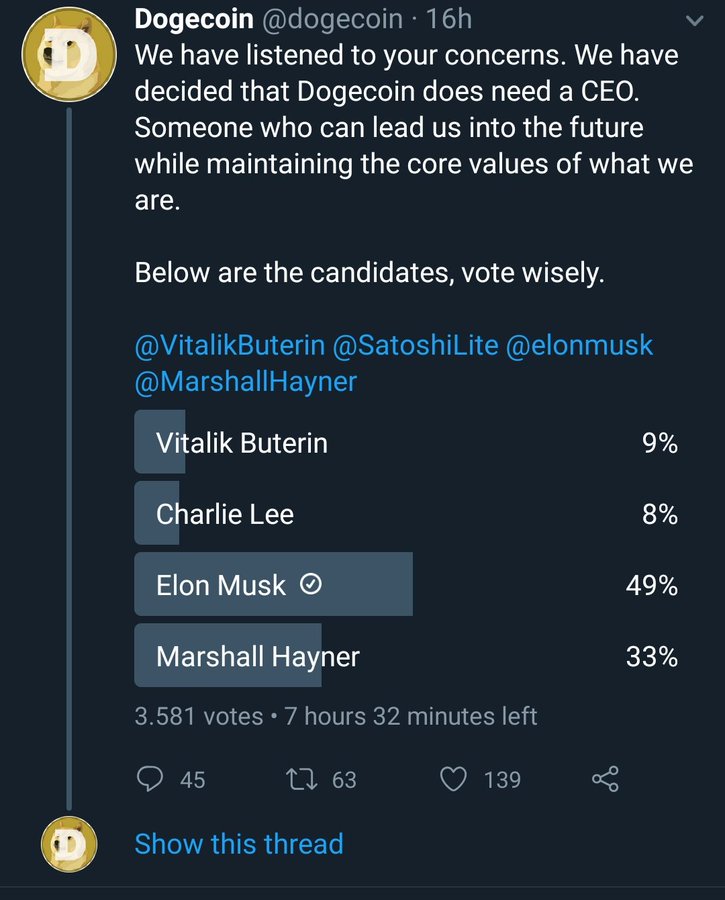
The Dogecoin was created back in 2013, and firstly no one took the currency seriously. Then all the sudden the currencies has become of the favorite among the crypto community and investors. Popular people like Tesla’ CEO, Elon Musk and the McAfee security’s John McAfee has praised the currency on social blogging site Twitter.

The registering of the Dogecoin by the leading cryptocurrency exchange has surged the value of the Dogecoin by 33%. Currently, Dogecoin is trading at the value of $0.004470 and its value is increased by 33.88%. The market capitalization of the currency is $537,425,682 USD. Binance has declared that the Dogecoin trading pair will be available to the customer on July 5, 2019, at the 12:00 UTC.

The CEO of the Binance Exchange, Changpeng Zhao (CZ), stated that this comes as an exception because in recent years there has not been any active development.

CZ Binance✔@cz_binance

This one is an exception, as there isn’t much new tech development (I guess it was never about the tech for this one). The users/community is large, and a famous “ex-CEO” (cough @elonmusk) helps!

Enjoy! https://twitter.com/binance/status/1147041439903125504 …Binance✔@binance#Binance Will Dogecoin ( $DOGE)https://www.binance.com/en/support/articles/360030488211 …2,39413:14 – 5 Jul 2019Twitter Ads information and privacy787 people are talking about this

In the month of April this year, Elon Musk has tweeted about Dogecoin and its become very famous on Twitter and in the crypto community. He tweeted, “Dogecoin might be my fav cryptocurrency. It’s pretty cool.”

Tom Heats@Tom_Heats · 2 Apr 2019

@elonmusk You can’t decline!

View image on Twitter

Elon Musk✔@elonmusk

Dogecoin might be my fav cryptocurrency. It’s pretty cool.7,89914:54 – 2 Apr 2019Twitter Ads information and privacy2,066 people are talking about this

The tweet instantly become famous and it got more than 10,000 replies, likes and, retweets. After the expected response received by people, Elon Musk jokingly changed his Twitter profile stating that ‘he was the CEO of Dogecoin’.

The currency is ranking at the 27th position in the cryptocurrency market and it has passed the currencies such as Qutm and Bitcoin Gold today.

Government of Cuba gradually seems to be realizing the true potentiality of the Crypto Market


A piece of major news came along from the government of Cuba which seems to gradually realize the true potentialities of the crypto market.

The news drew the attention of the entire market when President Miguel Diaz-Canel and his government on state-run TV officially announced that almost a quarter of the population will soon witness a rise in their income.

As far as the primary objective of the government is concerned, it plans to enhance the national supply as well as demand with a view of boosting growth. This is so because the sanctions imposed by the US President mainly target foreign investment and tourism.

Therefore, while his speech on the national television, Alejandro Gil Fernandez, the country’s Minister of Economy and Planning, said:


“We are planning to explore the potential application of cryptocurrency. In fact, we’ve gone further and decided to study the potential use of cryptocurrency in national and international commercial relations.”        

Moreover, Gil Fernandez also indicated a ray of hope by believing in the talent of Cuba. He seems to be quite confident about the announcement and firmly stated that this was going to be a long-term project. He also added that there is no denial in the fact that there is enough capability as well as talent in Cuba to make the use of cryptocurrency a reality and use it more effectively as a feasible means of payment.

Litecoin Wins the Weekly Gain Race Among The Top 10 Cryptocurrencies


Yesterday, the cryptocurrency market was enjoying its bullish movement, but today the market is again under the bearish pressure. The top ten currencies were going upward yesterday and gaining a surge in their prices and for everyone’s surprise, Litecoin has won the race among the other top ten cryptocurrencies in the market.

Litecoin’s value has been increased by 5% and on the other hand, the world’s largest cryptocurrency who regained its value above $11K has experienced an increase in its value by only 1%.

But, unfortunately, Litecoin and other top 10 now are trading under the bearish pressure and their value is decreasing. Currently, Litecoin is trading at the value of $119.55 USD and its value is decreasing by -3.26%. While Bitcoin is trading at the value of $11,227.34 USD and its value is decreasing by -3.82% at the time of writing. The year-to-date gain of Litecoin and Bitcoin was 305 and 217 respectively.

On the other hand, yesterday Ethereum and Ripple were not having any gains instead their values are decreasing by -3 and -6 respectively and their year-to-date gains were around 120 and 13. The other currencies such as Bitcoin Cash having a weekly decrease of -3 and the year to date gain of 162.

EOS’s was also experiencing a decrease of -4 and year-to-date gains of 133, Binance coin and Bitcoin SV were experiencing the weekly gains by 1 respectively and year-to-date gains by 481 and 124. Tron’s value was also decreasing by -4 and it is year-to-date gain was 73. And in the last Cardano, the currencies was the biggest loser and its value was decreasing by -10 and the year-to-date gain was 97.

This surging performance by Litecoin might be due to the mining reward halving, which is due on August 06, 2019. The target of the procedure is to restrict surging by decreasing the coins rewarded out for the mining on the blockchain of litecoin in half. Therefore, after the August 06, the currency miner will be getting 12.5 for every single block mined. That will be decreased by 50% of the present reward of 25 coins.

Importantly the miner will add fewer coins to the system and which will result in less circulation in the market. This might have assisted the Litecoin to surge in these seven days. On the other hand, it looks completely fine when a currencies surge further in a raise to an event and have restricted options upward. Yet, Litecoin has experienced immense growth this year and it has year-to-date gain above 300 percent. Litecoin has shown growth both on price and non-price metrics.

The hash rate of Litecoin has also increased up to as high as 468.1018 TH/s this week. It was on 146.2118 TH/s in December and it is increased by around 200 percent. The are chances that Litecoin will experience an immense pullback in the run-up to the halving high event of August 06.
Previously, at the time of halving of August 25, 2015, the value of the Litecoin won’t downhill from $8.72 to $2.55 just in the course of 6.5 weeks following up to the reward halving.

In a 3-day technical chart is also showing that the value will drop. The bullish higher lows and higher highs pattern is also complete. The RSI signal shows bearish divergence and 5- and 10- candle moving averages have also created bearish crossovers.

As the value risks were to falling at 200-candle moving average, which is at $221. Any breach will expose 50-candle MA which is at $83.00. And if the price will break above then the value of $140, then there will need to expose the big resistance which at the value of $182 (high of May 2018).

The Crypto Market Bleeds! Here’s All You Need To Know

Recently, there was a sharp decline in bitcoin cash price below the $440 and $420 supports against the US Dollar. The BCH/USD pair had even spiked below the $400 support and it is currently consolidating above the $400 level. 

On the upside, there are a few important resistances near the $420 and $425 levels. If there is an upside break above the $425 level, BCH could start a decent recovery in the near term. On the downside, the main support is near the $400 level, below which the price could decline sharply.

Likewise, EOS price declined heavily below $6.000 before the bulls appeared near the $5.600 level. The price recovered above $5.750 and it is currently consolidating above the $5.800 level. On the upside, a break above the $6.000 level is needed for a decent recovery in the near term.

Tron price settled below the key $0.0350 and $0.0332 support levels. TRX price even spiked below $0.0320 and it is currently trading in a range. To start an upside correction, the price must break the key $0.0332 resistance level.

Binance coin (BNB) unfortunately, declined below the $34.00 and $33.50 support levels. However, it managed to stay above the $32.00 support level and it is currently consolidating. To start a decent upward move, BNB price must move back above the $33.50 and $34.00 resistance levels. 

Looking at the total cryptocurrency market cap 4-hours chart, there were heavy losses below the $325.0B support area. The market cap stayed above the $290.0B support but recently failed. It broke the $290.0B support and a bullish trend line. It tested the next main support near the $275.0B level and it is currently correcting higher.

 However, a break above the $300.0B and $305.0B levels is needed for a decent recovery. If not, there is a risk of more losses in bitcoin, Ethereum, TRX, LTC, EOS, ripple, ADA, XLM, WTC, BCH, and ICX in the near term.

Design a site like this with WordPress.com
Get started